
The manufacturing process of vessel propeller shaft involves forging, cutting, and heat treatment. Forging strengthens the internal structure of the shaft material, improving its strength and toughness. After forging, the boat shaft is cut to achieve precise dimensions and a smooth surface. This includes machining key slots, threads, and other features on the shaft body to accommodate couplings and other components.
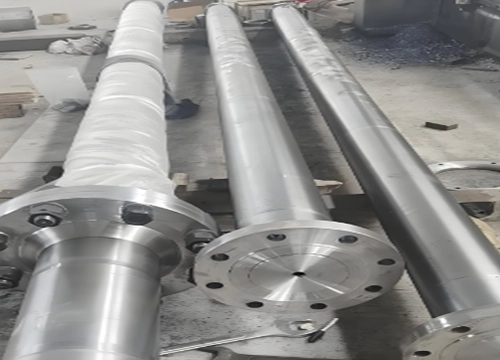

Solid shaft is a simple and direct type of propeller shaft, whose entire shaft body is a solid metal cylinder.
Solid shafts are suitable for small and medium-sized ships, especially those that require high strength for propeller shafts but are less sensitive to weight. Hollow shafts are widely used in large ships and ships that are sensitive to weight.
For example, on large ocean going oil tankers, container ships, and other vessels, the weight of hollow shafts is relatively light, which can effectively reduce the self weight of the vessel, thereby improving its carrying capacity and fuel economy.
The marine boat propeller shaft needs to withstand enormous axial force, torque, and bending force during operation.
Its strength and stability are directly related to the structural integrity of the ship. If the marine shaft breaks due to insufficient strength or fatigue damage, it may cause the propeller to detach, leading to severe shaking, loss of balance, and even sinking of the ship.
Therefore, the propeller shaft in ship must have sufficient strength and fatigue resistance to ensure safe and reliable operation during long-term sea navigation.
When it comes to reliable propulsion for vessels, the marine propeller shaft is an unsung hero—one of the most critical components in translating engine power into forward motion. A high-quality propeller shaft ensures that torque from the engine is transmitted smoothly and efficiently to the propeller, enabling predictable and steady performance even under heavy loads.
One of the major advantages of a well-designed propeller shaft is efficient power transmission with minimal loss. Because the shaft provides a direct mechanical link between the drive system and the propeller, energy loss is kept to an absolute minimum, which means better fuel economy and greater thrust output for the same engine power.
Durability and structural integrity are also key strengths. A sailboat propeller shaft must withstand harsh operating conditions — high torque, dynamic loads, corrosion, vibration, and misalignment — all while maintaining precise alignment. Choosing the right materials and machining ensures long life, less downtime, and reduced maintenance costs.
Another important benefit is the tubular/hollow design often used in advanced shafts, which balances strength and weight. That means less rotational inertia, better response, and lower stress on bearings and other connected components.
From a safety and operational standpoint, proper shaft design helps reduce vibration, noise and stress on the hull or engine mountings. Fewer vibrations translate to fewer fatigue issues in surrounding structures, better crew comfort, and less fatigue on connected systems.
Finally, a well-engineered marine propeller shaft offers versatility and adaptability across different vessel types and propulsion configurations: whether you're retrofitting an older ship, building a new one, or optimizing for performance, you can tailor attributes such as length, bore size, material grade, balancing, and coupling style to match your specific application.


 English
 Español
 italiano
 português
 Nederland
 norsk
norsk